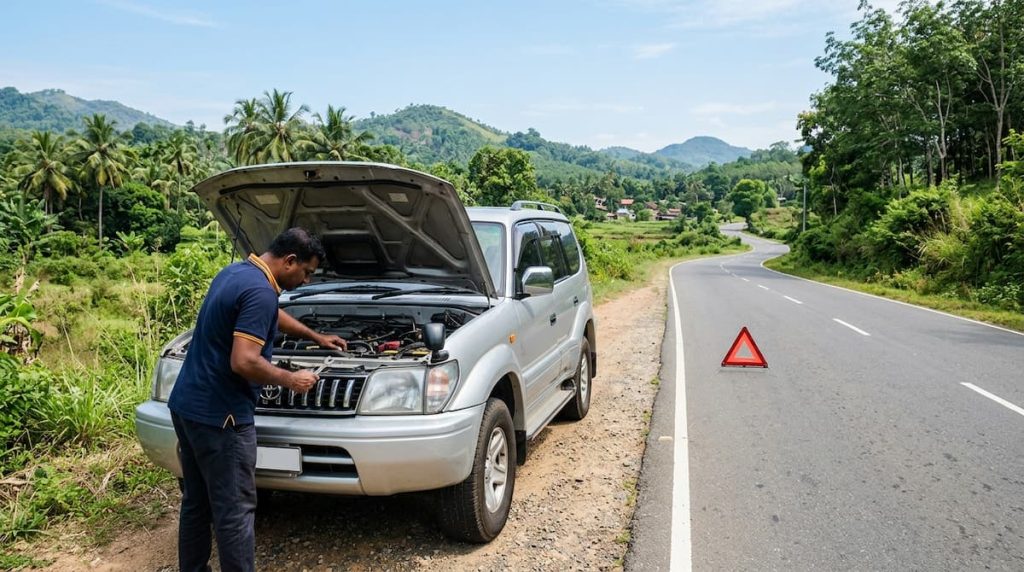
When a vehicle stops unexpectedly, most drivers assume the same thing: a tow truck is coming, and an expensive day is ahead. It’s a reasonable fear, but often it’s simply not true. A large share of breakdowns are fixed exactly where they happen, in a matter of minutes, without the vehicle ever going onto a truck. Understanding what actually decides between a roadside repair and a recovery helps you know what to expect — and what you should be paying for.
When a roadside fix works
The good news is that the most common breakdowns are also the most fixable on the spot. A flat battery is the clearest example: a jump start takes a few minutes and you drive away under your own power. A jump start service handles this without any need to move the vehicle at all.
The same is true of a flat tyre when there’s a serviceable spare flat tyre assistance swaps it at the roadside and you’re on your way. Running out of fuel is solved the same way: fuel delivery brings enough to reach the nearest station. And a lockout, where nothing is mechanically wrong at all, is resolved by a vehicle lockout service opening the vehicle safely.
What these situations share is that the vehicle is fundamentally sound — it just needs one specific problem solved before it can continue. In every one of these cases, reaching for a tow truck would be slower, more expensive, and completely unnecessary.
When recovery is genuinely required
Some breakdowns, though, cannot be fixed with the car sitting on the roadside — and trying to force it would risk making things worse. A seized engine, a failed clutch or gearbox, serious overheating that has already caused damage, accident damage, or a vehicle that has left the road all fall into this category. In these cases the vehicle needs to be moved, not restarted.
Here the right answer is a recovery service or a tow truck to lift the vehicle and carry it to a workshop. The distinction matters for your vehicle’s safety, too: driving a car with a seized engine or an overheating problem even a short distance can turn a repairable fault into a written-off one. A proper recovery protects the vehicle as much as it moves it.
For certain vehicles — prized cars, low-clearance vehicles, or anything that shouldn’t be driven onto a truck under its own power — a flatbed car carrier is the safest way to transport it, keeping all four wheels off the road for the whole journey.
The judgement call in the middle
Between the clear-cut cases sits a grey area, and this is where experience matters. A car that overheated but cooled down might be safe to move a short distance, or it might not — it depends on why it overheated. A tyre with no usable spare can’t be fixed roadside but doesn’t necessarily need a full recovery if it can be made safe to limp to a nearby garage. A warning light might mean “stop immediately” or “book a service this week.”
A good roadside crew makes this judgement with your interests in mind, not the truck’s. The honest question is always the same: what is the fastest, cheapest, safest way to get this driver moving again? Sometimes that’s a five-minute fix. Sometimes it’s a careful recovery. The answer should be driven by the vehicle’s actual condition, not by which option earns more.
What it means for what you pay
This is where the distinction hits your wallet. A roadside repair is almost always cheaper than a recovery — there’s no truck, no loading, no transport distance to pay for. That’s precisely why any service that reaches for the tow truck by default deserves a little scepticism. If every call ends with your car on a flatbed, something is off.
A fair operator quotes based on what the job actually needs. When you call, describe the situation honestly — what happened, whether the car still runs, whether there’s a spare — and you should get a clear answer about whether this is a roadside fix or a recovery, and a firm price for it, before anyone sets off. You approve that before work begins.
How to help the person helping you
You can make the roadside-versus-recovery decision faster and more accurate by giving good information up front. Tell whoever you call exactly what happened and when: did the engine cut out suddenly, or did a warning light come on first? Does the car still start? Is there smoke, a smell, or a noise? Do you have a spare tyre and the tools? The clearer the picture, the better the crew can arrive with the right equipment — and the less likely you are to wait around while the wrong vehicle is sent.
Above all, know who you’re going to call before you need them. Whatever has stopped you, our breakdown service covers both ends of this spectrum — the quick roadside fixes and the full recoveries — across Sri Lanka, around the clock. If you’re not sure which you need, that’s exactly what our roadside assistance team is there to work out with you.